Retool is a far broader product than cartapel, and the comparison is only fair if that is said first. It is a general internal-app builder: drag components onto a canvas, wire them to dozens of data sources — Postgres beside REST, GraphQL, Snowflake, Stripe, S3 — and glue it together with JavaScript anywhere a value can go.
cartapel does one narrower job: a CRUD and dashboard panel over SQL databases you already run. If your internal tool spans three services and a payments API, Retool is the honest answer and this page will tell you so.
The reason teams look for an alternative is usually not features. It is the model: proprietary and priced per user, a multi-container stack if you self-host, and apps authored in a GUI whose reviewable artifact is generated JSON. cartapel is the opposite trade — one MIT binary, no seats, and configuration that is a handful of HCL files a reviewer reads in a pull request.
Build it by clicking if you like — what gets published is HCL in your repo, not app JSON in a database you do not control.
Side by side
cartapel
Retool
Scope
Admin panel over SQL databases
General internal-app builder over any source
Data sources
Postgres, MySQL, MariaDB (+ ClickHouse read-only)
Dozens — SQL, REST, GraphQL, SaaS APIs
Self-hosting
One Rust binary
Multi-container deployment, or SaaS
Authoring
Visual editor or HCL by hand — both produce files in git, reviewed in PRs
GUI-first; git sync on paid tiers, as generated JSON
Pricing
MIT, free, no seats
Proprietary, per user, per month
Audit log
Built in — before/after diff, one-click revert
Audit logs on higher tiers
Time to a working panel
Introspected — every table works before you configure it
You build each screen
Custom logic
Declarative actions; JS only inside custom widgets
JavaScript everywhere, arbitrary workflows
Yellow cells are nuanced — the sections below say why.
Where Retool is the better answer
Your tool is not a database panel. Approval flows that call three services, a support console stitching Stripe to your database to Zendesk — that is what Retool is for and cartapel does not attempt it.
Non-SQL sources are first-class. REST, GraphQL, warehouses and SaaS connectors, with the auth handled for you.
You want to build UI by dragging. Some teams genuinely prefer a canvas, and Retool has the deepest component library in this category.
Enterprise checkboxes now. SSO, SCIM, granular org permissions and support contracts are mature and purchasable.
Where cartapel is the better answer
The panel is over your own database. Introspection means the boring 90% — list, search, filter, detail, inline edit, foreign keys as links — exists before you write a line of config.
No per-seat bill. Adding the whole support team costs nothing, so nobody ends up sharing a login to save money.
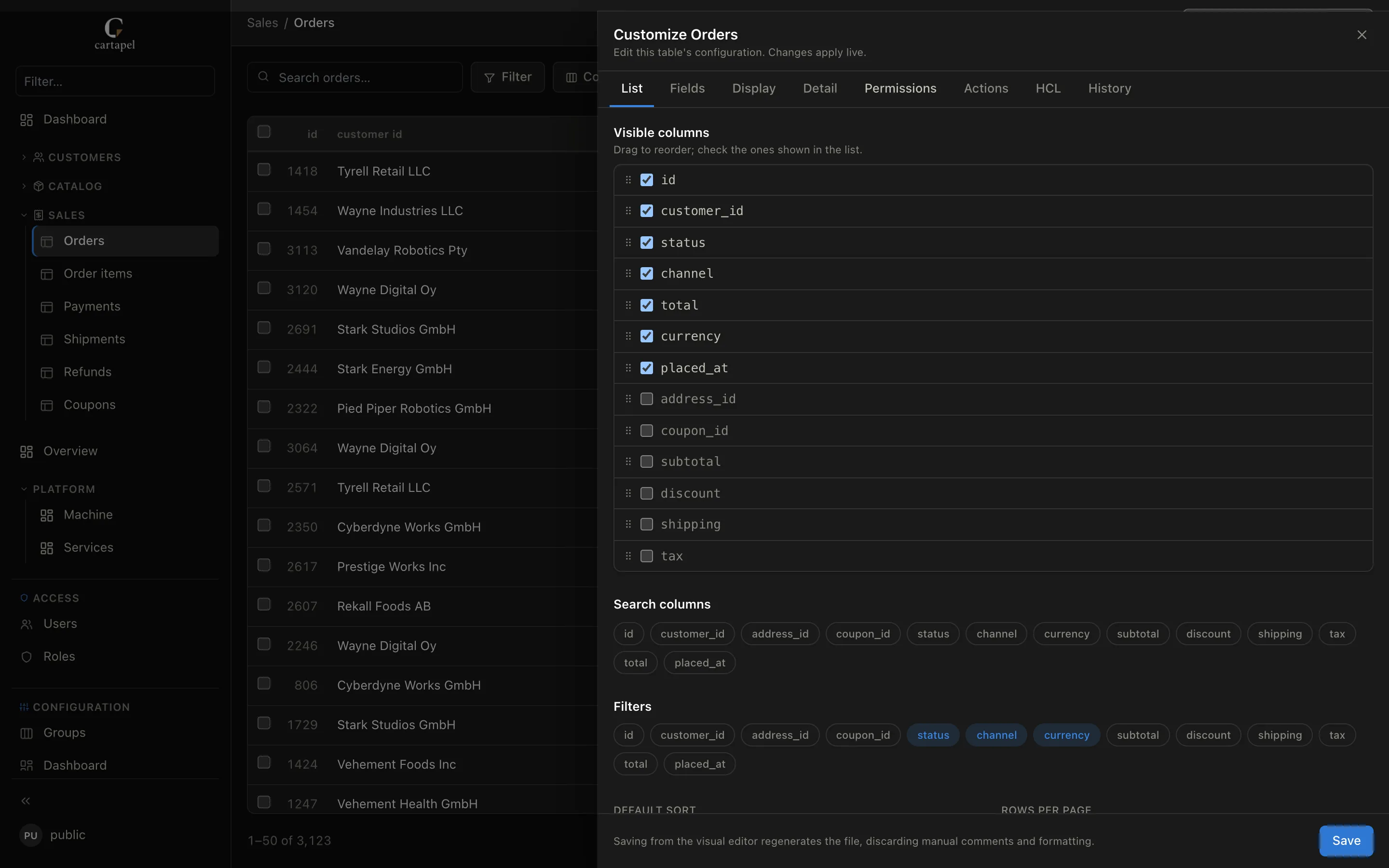
You get the GUI and the file. Build a screen, a permission set or a dashboard tile in the panel's own editor, see the diff, publish — and what lands is HCL in your config directory, hot-reloaded. On a read-only deployment it hands you the HCL to commit instead.
The configuration is the review. A diff of HCL is readable; a diff of exported app JSON is not. Changes ship through the same pipeline as your code.
It does not want to own everything. Dashboards are SQL tiles you write, and a Grafana panel you already maintain can be embedded as an iframe widget instead of rebuilt.
Self-hosting is trivial. One binary or one container with a database URL — no orchestration, no license server, and your production data never leaves your network.
The short version
Pick Retool if You need apps over many sources with custom logic — Retool, or Appsmith and Budibase in open source.
Pick cartapel if You need a safe, audited panel over databases you already run, owned outright and free per user.
No login. Click anything — the demo resets on a schedule.
Questions people actually ask
Is cartapel a drop-in Retool replacement?
No. It replaces the most common Retool use case — internal CRUD over your database, with roles and an audit trail — not the app builder. If your Retool apps orchestrate external APIs, cartapel is the wrong shape.
What does cartapel cost at 50 users?
Nothing. It is MIT licensed with no seat counting, no feature gating and no license key; you pay for the machine it runs on.
Can I keep app state and logic in version control?
That is the premise. Screens, fields, actions, roles and dashboards are HCL files in your repository, reviewed in pull requests and deployed like any other change.
Does it connect to REST APIs?
No. Sources are SQL databases: Postgres, MySQL and MariaDB read-write, ClickHouse read-only. Several can be mixed in one panel, but an HTTP endpoint is not a source.