These two are less rivals than neighbours, and picking between them usually means one of the two teams asking has the wrong tool in mind.
Metabase is a business-intelligence tool, and at BI it is better than cartapel by a wide margin: self-serve question building for people who do not write SQL, drill-through, scheduled reports, alerts, embedded analytics. cartapel has SQL dashboards — stat tiles, charts, template variables — and does not try to approach that depth.
The same goes for Grafana, which many teams already run for metrics: cartapel sits beside it rather than replacing it, and a Grafana panel can be embedded straight into a cartapel dashboard as an iframe widget, next to the SQL tiles and the tables people edit.
What Metabase is not is an admin panel. It is read-oriented by design: editing a row, running a bulk action, importing a CSV into a production table or granting write access to one column and not another are not jobs it takes on. That is the entire subject of cartapel.
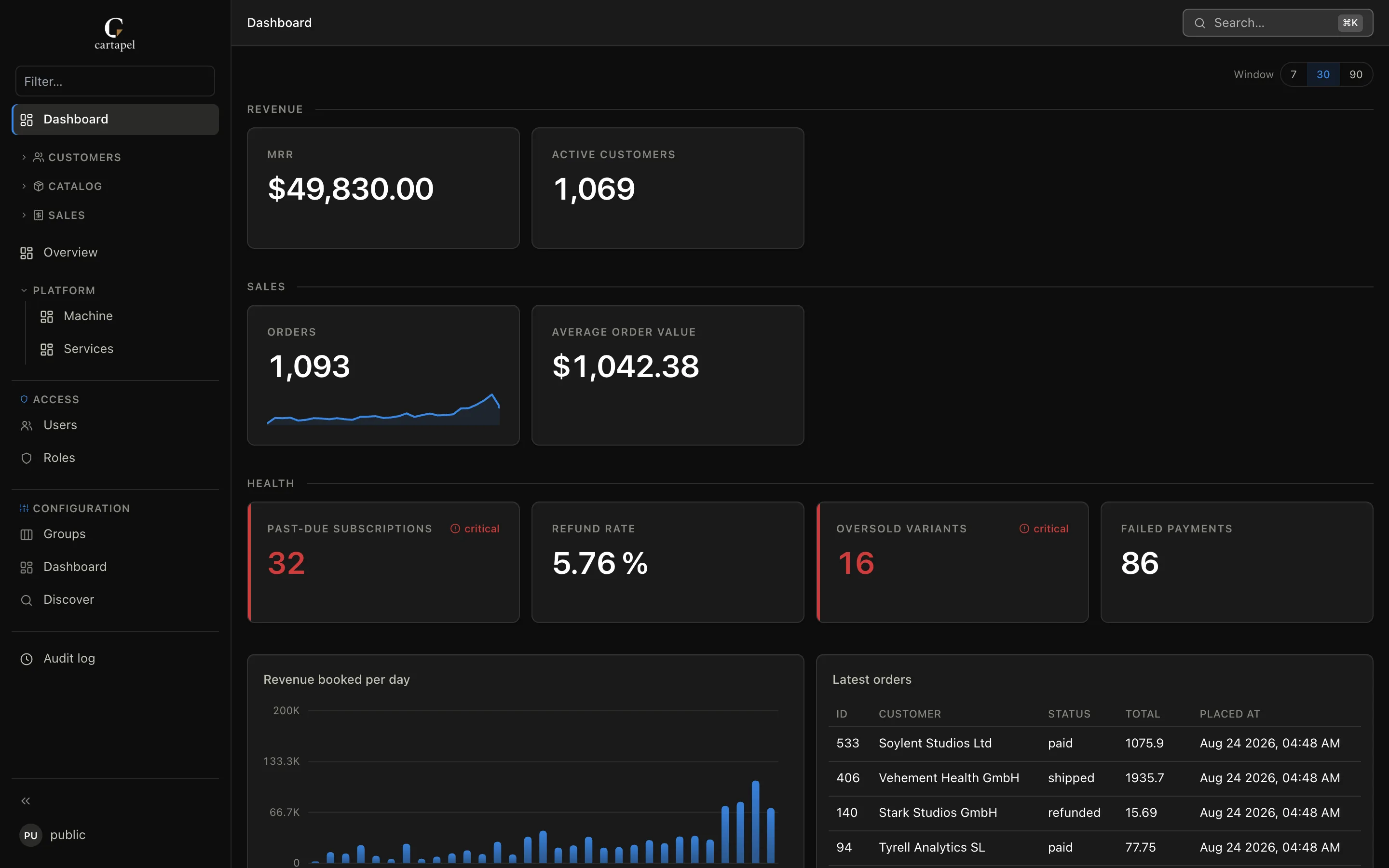
The dashboards here are operational tiles you author in SQL — not a replacement for self-serve BI.
Side by side
cartapel
Metabase
Primary job
Operations — read and write records safely
Analytics — ask questions of the data
Editing data
Inline edit, forms, bulk actions, imports
Read-oriented; limited actions
Charts and exploration
SQL tiles and charts you author, plus embedded Grafana panels
Best-in-class self-serve BI
Write permissions
Per table, per column, per row, with inheritance
Read permissions; sandboxing is a paid feature
Audit of changes
Built in — before/after diff, one-click revert
Not the model — little is written
Runtime
One Rust binary
JVM application
Configuration
Visual editor or HCL by hand — both produce files in git, reviewed in PRs
GUI; serialization to files is a paid feature
License
MIT, free, no seats
AGPL core, paid Pro and Enterprise tiers
Yellow cells are nuanced — the sections below say why.
Where Metabase is the better answer
Non-technical people need to ask their own questions. The query builder, drill-through and saved questions are the product, and nothing in cartapel substitutes for them.
Scheduled reports and alerts. Email and Slack delivery, thresholds, subscriptions — mature and out of the box.
Many warehouses and sources. BigQuery, Snowflake, Redshift and the rest, which cartapel does not speak.
Embedded analytics for customers. A supported, well-trodden path.
Where cartapel is the better answer
Someone has to change the record. Fix an address, refund an order, flip a flag — with a confirm dialog, a permission check and a diff, not a SQL console.
The write side needs permissions. A support role that may edit two columns of one table, with everything else read-only or hidden, is config rather than a paid tier.
You want the change reversible. Every write lands in an audit log with before and after values and a revert button.
It sits beside what you already run. If Grafana owns your metrics, keep it — a Grafana panel drops into a cartapel dashboard as an iframe widget, so operations and observability live on one screen.
Small footprint. One binary next to your database rather than a JVM service to size and babysit.
The short version
Pick Metabase if The job is charts, exploration and reporting — Metabase, and it is not close.
Pick cartapel if The job is a safe, audited panel where people change records — cartapel, beside Metabase rather than instead of it.
No login. Click anything — the demo resets on a schedule.
Questions people actually ask
Can cartapel replace our Metabase dashboards?
Some of them. Stat tiles, charts and tables from SQL with template variables cover the operational dashboard an ops team keeps open. Self-serve exploration for analysts is not the same job and Metabase keeps it.
Do the dashboards run against production safely?
Dashboard SQL runs in read-only transactions with a statement timeout, and every value is a bound parameter, so a tile cannot write or run away with your database.
Can we run both?
That is the usual arrangement: Metabase for analytics, cartapel for operations. They read the same database and neither owns the schema.