Baserow is an open-source Airtable, and it is a good one: grids, views, form building, collaboration and a plugin system, self-hostable under an open licence. If the question is where a small team should keep a new dataset, Baserow is a reasonable answer and cartapel is not.
The distinction that matters here is ownership. Baserow is happiest creating and managing its own tables inside its own database — that is the product. Connecting it to a production schema owned by an application is going against the grain, where cartapel is designed for exactly that: introspect what exists, change nothing, and expose only what you register.
The second distinction is where configuration lives. Baserow is configured by clicking, and that state sits in its database. In cartapel the panel is a directory of HCL files in your repository, reviewed in pull requests and deployed with your code.
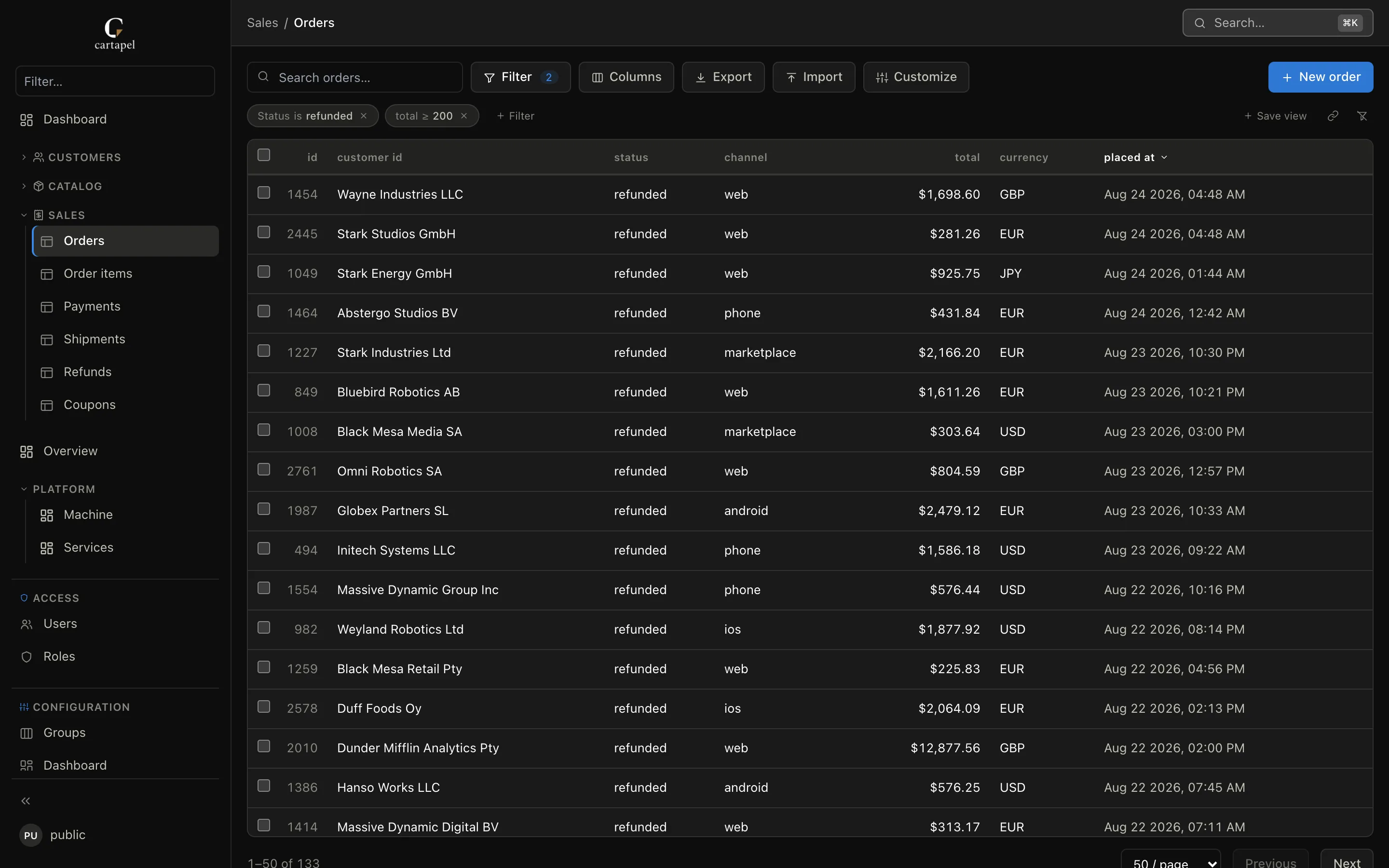
This table was not created here. It is your production table, read as it is.
Side by side
cartapel
Baserow
Where the data lives
Your existing database, untouched
Its own tables, in its own database
Existing production schema
The whole point — introspected at boot
Against the grain; import-oriented
Feel
Admin panel
Airtable-style no-code database
Configuration
Visual editor or HCL by hand — both produce files in git, reviewed in PRs
Clicked in the UI
Runtime
One Rust binary
Python and Node services
Audit and revert
Built in — before/after diff, one-click revert
Row history and trash, varies by tier
License
MIT, free, no seats
MIT core with paid premium/enterprise features
Yellow cells are nuanced — the sections below say why.
Where Baserow is the better answer
The dataset is new and has no application. Let Baserow own it and skip the migration entirely.
Non-technical owners. Building a table, a view and a form without asking an engineer is the whole value proposition.
Collaboration features. Comments, sharing and real-time editing that an admin panel does not try to provide.
Where cartapel is the better answer
The data already exists in Postgres, MySQL or MariaDB. Introspection rather than import; no second copy of the truth.
Schema changes come from migrations. A new column appears in the panel without anyone reconfiguring anything.
Ops needs guardrails. Per-column permissions, masked secrets, confirmable actions and a revertible audit trail.
Everything reviewable. Configure by hand or in the panel's visual editor — either way the result is HCL in your repository, so the panel's history is your git history.
The short version
Pick Baserow if The data does not exist yet and non-technical people should own it.
Pick cartapel if The data lives in a production database and an application owns the schema.
No login. Click anything — the demo resets on a schedule.
Questions people actually ask
Can Baserow and cartapel coexist?
Easily, because they answer different questions: Baserow for datasets a team owns outright, cartapel as the operations panel over the application database.
Does cartapel import data?
CSV import into allowed tables, subject to the same permissions and audit as any write. It is an admin function, not a migration tool.