This is less a competition than a boundary line, and most teams running cartapel keep pgAdmin installed.
For database administration — query plans, vacuum and bloat, replication, extensions, role grants, ad-hoc SQL against anything — pgAdmin (or psql, or DBeaver) is the right tool and cartapel does not replace any of it. cartapel never issues DDL and has no server administration surface at all.
What you should not do is hand pgAdmin to support staff. It exposes raw SQL over every table with no application-level roles, no column masking, no row filters and no trace of who changed what. One mistyped UPDATE without a WHERE is a bad afternoon, and nothing records it.
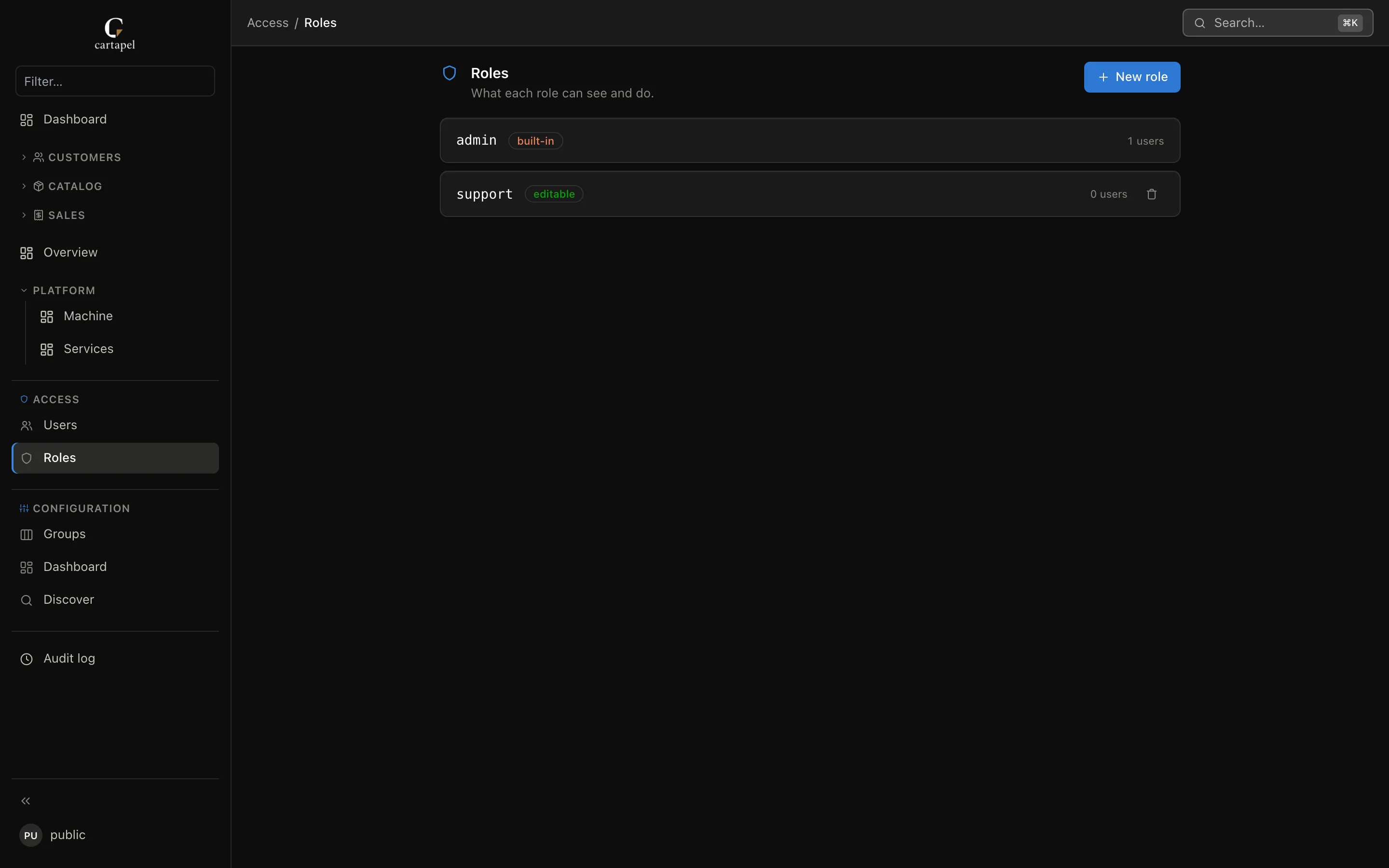
Roles, column masking and an audit trail are the difference between a DBA tool and one you hand to support.
Side by side
cartapel
pgAdmin
Audience
Support, ops, anyone in the company
Engineers and DBAs
Server administration
None — never issues DDL
Query plans, vacuum, replication, grants
Application-level roles
Per table, column and row, with inheritance
Postgres roles only
Secret columns
Secret-shaped columns masked by default
Everything is visible
Audit of writes
Built in — before/after diff, one-click revert
None
Databases
Postgres, MySQL, MariaDB (+ ClickHouse read-only)
Postgres only
Dashboards
SQL tiles and charts for the business
Server activity charts
License
MIT, free, no seats
PostgreSQL licence, free
Yellow cells are nuanced — the sections below say why.
Where pgAdmin is the better answer
Anything DBA-shaped. Explain plans, index maintenance, replication, extensions, tablespaces, grants.
Ad-hoc SQL with no guardrails. Sometimes an engineer needs exactly that, and the guardrails are the problem.
Schema work. Creating and altering objects, which cartapel deliberately never does.
Where cartapel is the better answer
People who are not engineers need access. An allowlist of tables, roles with inheritance, and a UI that does not invite a stray DELETE.
Someone will ask who changed this. Every write is logged with before and after values and can be reverted from the log.
Repeated operations should be one click. A refund or a status flip is a declared action with a confirmation, not a query pasted from a wiki.
Not only Postgres. MySQL and MariaDB are equal citizens, ClickHouse joins read-only, and several sources can share one sidebar.
The short version
Pick pgAdmin if You are administering the database server itself.
Pick cartapel if You are handing a panel to people who should never see a SQL prompt.
No login. Click anything — the demo resets on a schedule.
Questions people actually ask
Can cartapel run arbitrary SQL?
Dashboard tiles and pages are SQL you author in config, run in read-only transactions with a statement timeout. There is no free-form query console for panel users — that is a deliberate boundary, and where pgAdmin belongs.
How does cartapel limit what a role can see?
Tables are an allowlist, and roles carry per-table, per-column and row-level rules with inheritance and multi-role union. Secret-shaped columns are masked unless explicitly revealed.
Do I still need pgAdmin?
Almost certainly, and that is fine. Engineers use one, everyone else uses the other.